Blockchain Explained
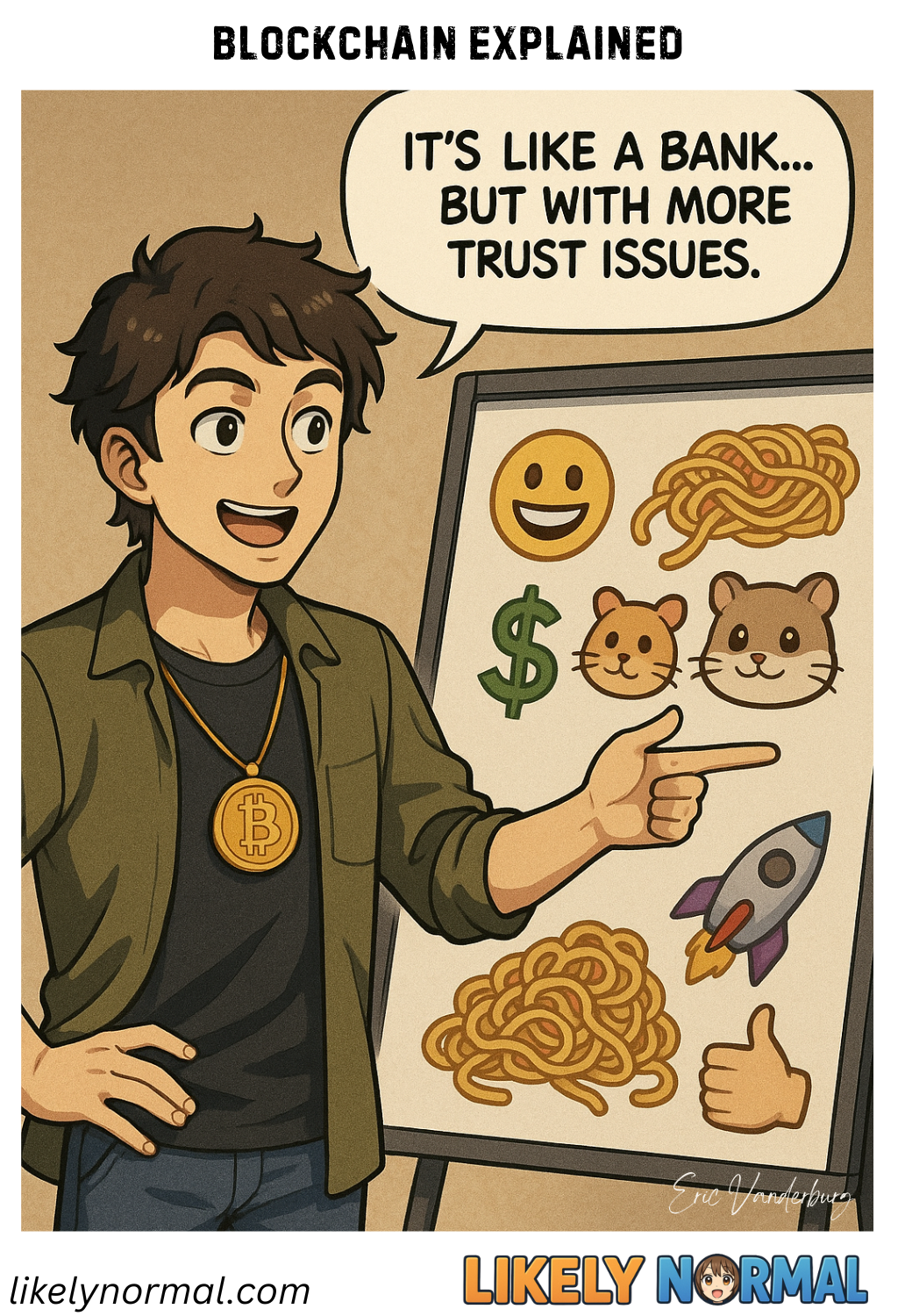
Blockchain promised to revolutionize finance, but instead it’s like a group project where everyone insists we don’t need a leader—and now your life savings are trapped in a Google Doc that may or may not be a scam. Sure, it’s like a bank, if banks were run by anonymous Twitter avatars, price charts that look like a polygraph test gone wrong, and a vision board that somehow includes “hamster on a rocket” as a legitimate economic model.
The trustless system somehow demands more trust than a blindfolded trapeze artist. You have to trust that the based devs aren’t actually three raccoons in a trench coat, that the next big coin isn’t just a JPEG of a cartoon monkey with a HODL speech bubble, and that your unhackable wallet won’t vanish faster than your enthusiasm after reading the terms and conditions. And let’s not forget the real innovation: replacing “too big to fail” banks with “too convoluted to explain” smart contracts that accidentally send your mortgage payment to a meme coin because someone misplaced a comma.
At this point, decentralized just means that no one is in charge, and also no one will help you. It’s like a group chat where everyone keeps saying DYOR (Do Your Own Research), but the research is just a Reddit thread titled “Trust me bro.” The tangled noodles? A perfect metaphor for tracing a transaction while questioning every life choice that led you here. The rocket? A reminder that crypto’s only consistent feature is its ability to launch your sanity into the stratosphere.
Blockchain isn’t just technology—it’s a vibe check for your risk tolerance. And if you’re still in after the 10th “this is fine” meme, congrats! You’ve officially leveled up to “will argue about gas fees at Thanksgiving.”
Discussion ¬