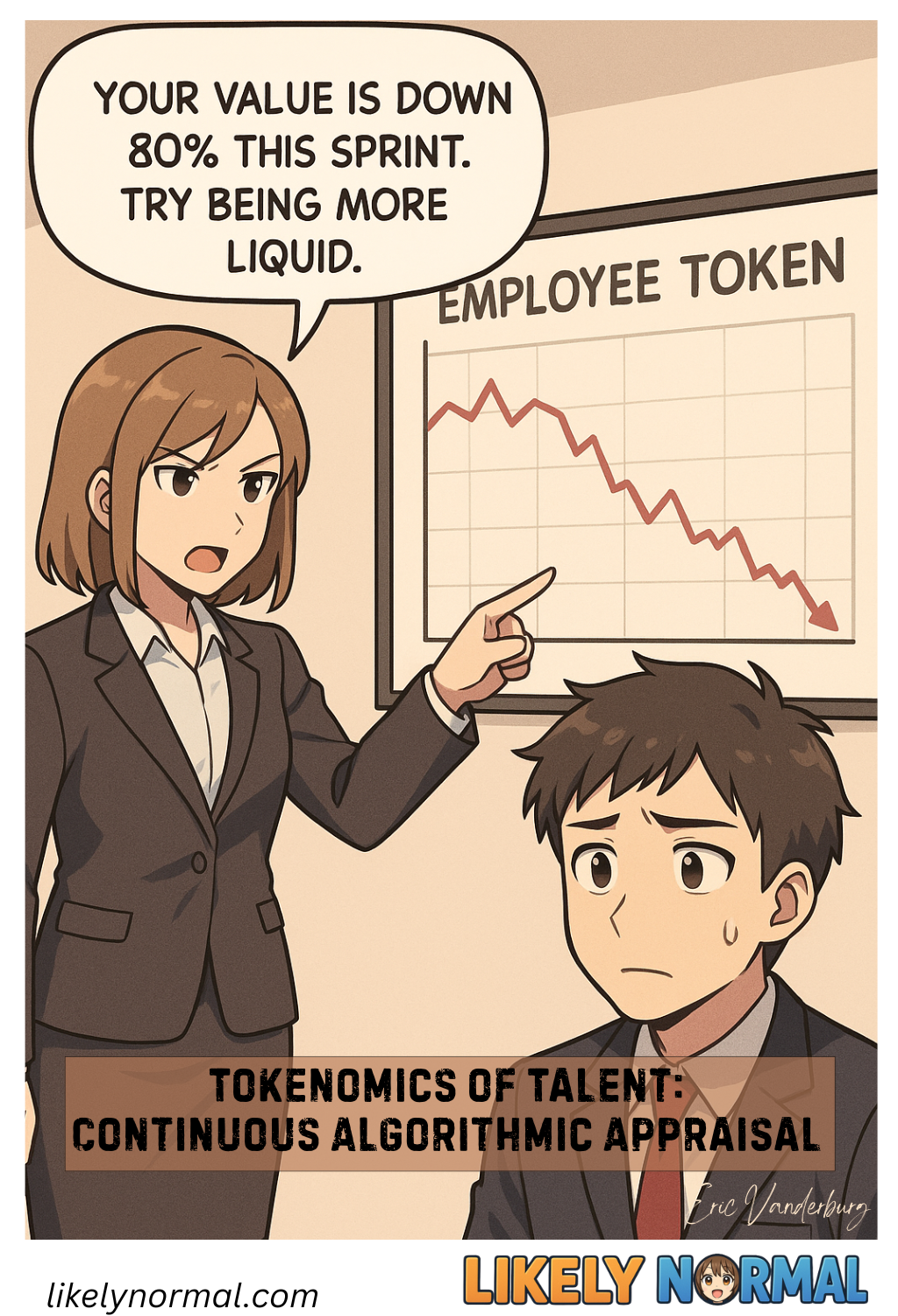
Tokenomics of Talent
There’s a special kind of corporate absurdity that happens when companies become obsessed with measuring every blink, keystroke, and bathroom break—turning human employees into glorified Excel cells that occasionally complain about burnout. The modern workplace has devolved into a never-ending game of “Who Can Look the Busiest,” where productivity is measured in meaningless metrics like emails sent per hour (regardless of whether those emails just say per my last email) or time spent actively moving the mouse (put the laptop on the running washing machine to avoid going idle). These tracking systems don’t measure value—they measure compliance with arbitrary rules designed by people who haven’t done actual work since the 80s. Nothing crushes morale faster than realizing your performance score is determined by an algorithm that thinks a 15-minute bathroom break is equivalent to stealing office supplies.
The irony is rich: managers who preach innovation and critical thinking simultaneously shackle employees to rigid KPIs that punish creativity. Why solve a complex problem when you could be grinding out mindless tasks that tick tracking software boxes? Why take risks when your annual review boils down to whether you hit your “keyboard activity” quota? These systems inevitably reward the wrong people—like Dave from Accounting, who spends all day mass-replying “Thanks!” to emails to inflate his responsiveness metric while actual high performers get penalized for, say, thinking before they type. Even worse? When the metrics contradict each other: “Increase customer call resolution speed!” but also “Achieve 100% satisfaction scores!” (Translation: Solve problems instantly… without ever rushing anyone off the phone. Good luck.)
The result is a workforce that feels like circus animals jumping through digital hoops—demoralized, dehumanized, and hyper-aware that their real “performance” is judged by how well they game the system. Because here’s the dirty secret: No one does their best work while being monitored like a felon on parole. The most valuable employees—the ones who innovate, collaborate, and actually move companies forward—are often the ones whose contributions can’t be neatly quantified in a dashboard. But try explaining that to a manager who thinks a pie chart of your “weekly active hours” tells them everything they need to know.
Discussion ¬