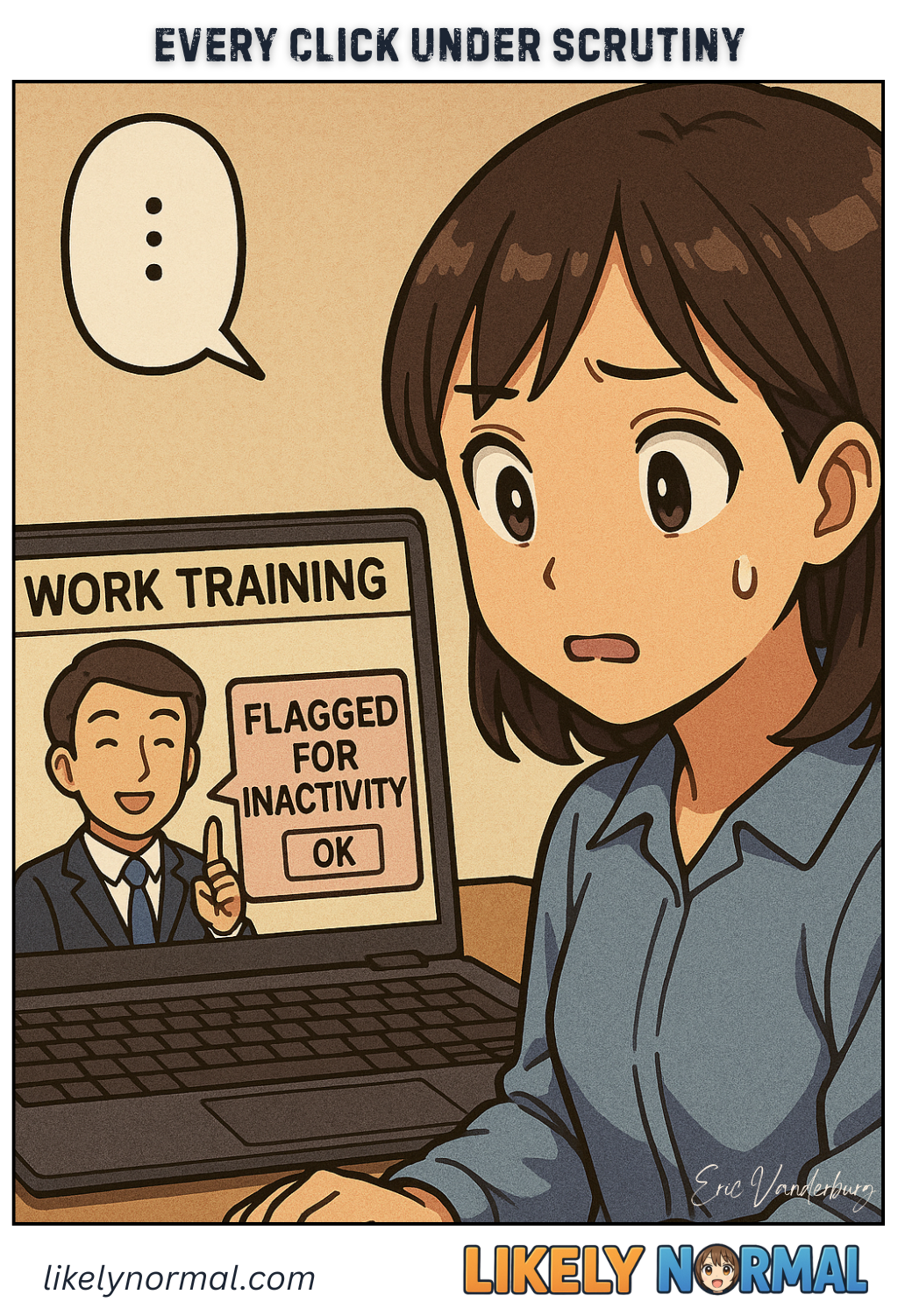
Every Click Under Scrutiny
There’s something uniquely demoralizing about being scolded by an algorithm for inactivity while watching a mandatory corporate training video that could put caffeine-fueled squirrels to sleep. You’re just trying to survive another 45-minute lecture on cybersecurity best practices when suddenly—pop-up!—the system accuses you of not paying attention because you dared to breathe without moving your mouse for 30 consecutive seconds. Never mind that you’ve been mentally composing your resignation letter in your head the whole time—that doesn’t count as “active engagement” in the eyes of our digital overseers.
The modern workplace has turned productivity monitoring into an art form, where every keystroke, mouse wiggle, and bathroom break is tracked with the precision of a NASA launch. Forget Big Brother—we’ve got Middle Manager Software that generates reports on how many minutes you spent “idle” between emails, as if human beings are just Excel cells waiting to be filled with data. The irony is almost beautiful: companies spend millions on systems to measure “efficiency” that ultimately make everyone less efficient, since employees now waste hours each week performing the theatrical equivalent of work just to keep the algorithms happy. Nothing says “peak capitalism” like paying someone to watch a computer program that watches you pretend to work.
The surveillance extends far beyond just catching you dozing off during compliance videos. Some workplaces now use AI to analyze facial expressions during Zoom calls, docking “engagement points” for insufficient smiling, while keystroke trackers create heat maps of your most “active” hours—which, coincidentally, always seem to align perfectly with when your boss walks by. There’s even software that monitors your chat response times, because God forbid you take three minutes to answer a Slack message instead of two. The message is clear: you are not a person, you are a series of metrics waiting to be optimized.
Of course, workers have responded with increasingly creative countermeasures. The rise of “mouse jigglers” (devices that simulate activity) has turned productivity into a game of “Fool the Robot Overlords,” while others maliciously comply by sending their bosses hourly spreadsheets titled “Proof of Breathing: 9:00-9:15 AM.” But most of us just sigh and play along, performing the digital equivalent of busywork to keep the algorithms at bay. After all, in a world where “productivity” means looking productive rather than actually being productive, the real skill isn’t your job performance—it’s your ability to fake it well enough to avoid a talking-to from HR.
So the next time your job’s tracking software pings you for “inactivity,” just remember: even screensavers get to rest sometimes. The rest of us? We’ll keep frantically jiggling our cursors like rats in a Skinner box, praying the system doesn’t notice when we zone out during the “Importance of Mental Health Awareness” seminar (scheduled, naturally, for 7 PM on a Friday). Happy pretending!
Discussion ¬