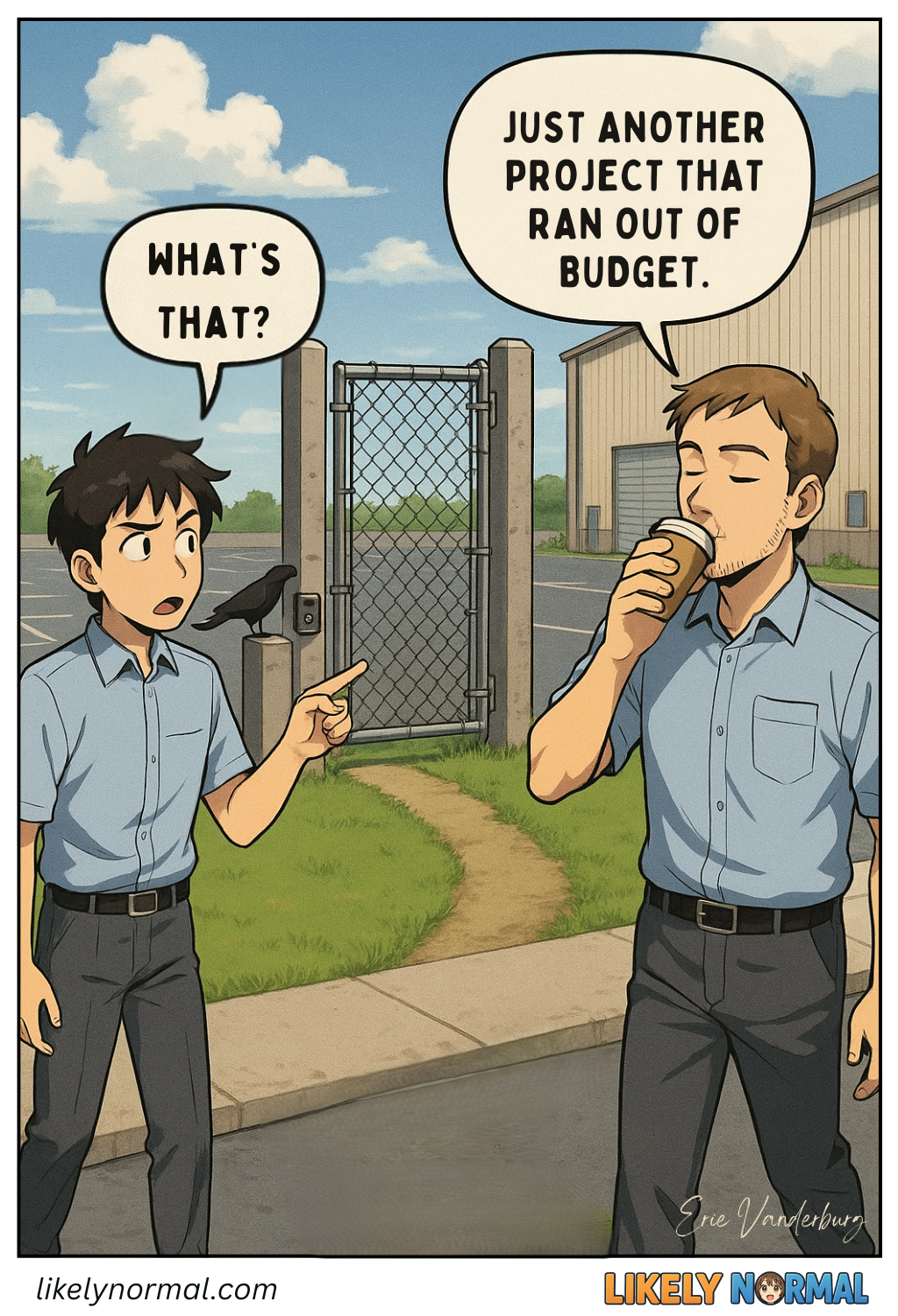
Budget Problems and Security Holes
Half-Baked and Fully Broken: The Art of the Abandoned Project
There’s a special kind of tragedy—or comedy, depending on how much you enjoy schadenfreude—in watching a grand project collapse into a half-finished mess because someone forgot to carry the zero in the budget spreadsheet. These doomed ventures start with PowerPoints full of pie charts and end with duct tape, unpaid contractors, and a lingering sense of “Wait, whose idea was this again?”
Take the Public Infrastructure Project That Ran Out of Money. One day, it’s a gleaming new bridge, a state-of-the-art transit system, or a pedestrian plaza that promises to “revitalize the community.” The next? It’s a concrete stump leading nowhere, a single lonely train track that dead-ends into a fence, or a “plaza” that’s just a slab of pavement with a single sad bench (bolted down, because people will steal it). The official press release calls it *”Phase 1 of a multi-stage vision.”* The public calls it “that weird place where teenagers take Instagram photos now.”
Then there’s the Corporate Software Rollout that got axed halfway through. The sales team promised AI-powered blockchain cloud synergy; the engineers delivered a login screen that crashes if you type your password too fast. Management declares victory anyway (“We’ve established a framework for future innovation!”) while the IT department quietly disables the whole thing and pretends it never existed. Employees are left with a useless dashboard that just says “Module Not Licensed”—a haunting digital tombstone for budget cuts past.
Home renovations are especially prone to this. What begins as a “Let’s open up the kitchen!” ends with a half-demolished wall, a microwave in the living room, and a tarp that’s been “temporary” for 14 months. The contractor stopped returning calls, the budget evaporated, and now you just… live like this. Guests ask, “Oh, are you remodeling?” and you reply, “Yes,” because “No, this is just my life now” is too depressing.
And let’s not forget Event Planning on a Shoestring. The “Winter Festival” becomes three folding tables and a guy in a moth-eaten snowman costume handing out expired candy canes. The “Company Retreat” is just everyone standing in a parking lot with boxed lunches, squinting at a Zoom call on someone’s laptop. The budget didn’t account for “things costing money,” so the motto becomes “Fake it ’til you abandon it.”
The real kicker? These projects aren’t just incomplete—they’re often actively hazardous. The bridge with no guardrails, the app that stores passwords in plain text, the “finished” deck that wobbles like a Jenga tower—they all whisper the same universal truth: “We were so close. And yet, so, so far.”
In the end, these monuments to poor planning serve a purpose. They remind us that ambition is cheap, execution is expensive, and no matter how fancy the PowerPoint, eventually, someone has to do math. So here’s to the abandoned, the underfunded, and the “good enough.” May your tarps stay waterproof, your error messages stay cryptic, and your contractors eventually pick up the phone.
Signs Your Project is Doomed:
- The words “interim solution” have been used more than once.
- The budget spreadsheet has a tab called “Misc. Hail Marys.”
- You’ve started referring to obvious flaws as “quirks.”
- The ribbon-cutting ceremony is just people awkwardly nodding at a construction fence.
Discussion ¬