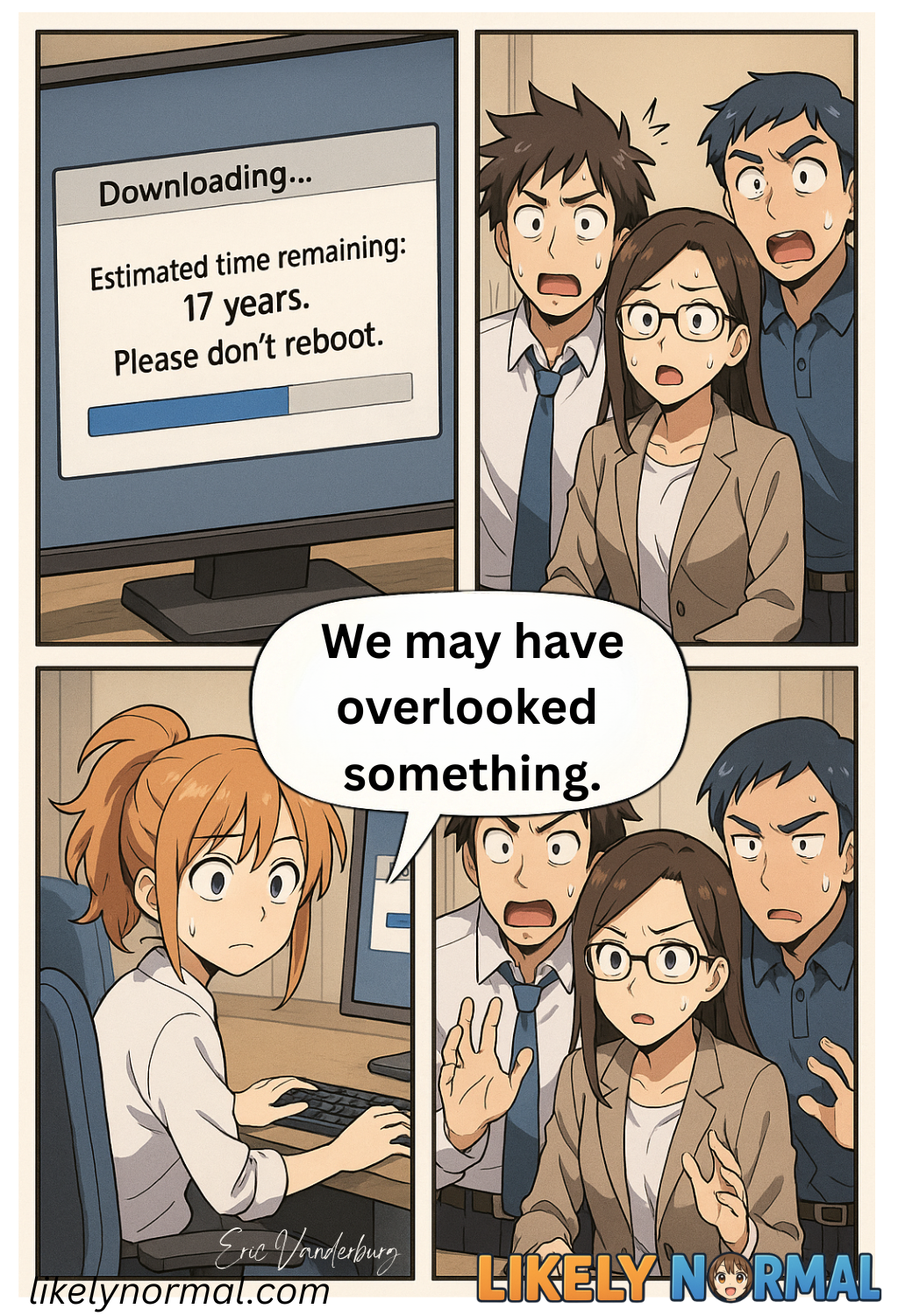
Glad We Have Backups
A client of mine had backups and then was hit with ransomware. Unfortunately for them, they learned that their backups would take days to download from the cloud. This was something that should’ve been tested to ensure it met with their recovery time objectives, but it was overlooked. Technology is complex and there is a lot to consider when designing solutions.
Cloud backups are like parachutes—thrilling to know you have one, but you really should test it before jumping out of the plane. Turns out their “bulletproof” disaster recovery plan had one tiny flaw: it moved data at the speed of an arthritic sloth carrying a USB stick uphill. Who knew that downloading 50TB over a “business-grade” internet connection would take roughly the same amount of time as watching the entire Lord of the Rings trilogy… in extended edition… twice?
The tech gremlins at play here are delightfully predictable: your “high-speed” connection that mysteriously throttles to dial-up speeds the moment you need it most, backup software that prioritizes “verifying checksums” over basic human decency, and a restore process that apparently runs on a single Raspberry Pi someone forgot in the server closet. It’s the perfect storm of “this should work” meets “why is the progress bar going backwards?”
Moral of the story? Testing your backups isn’t just checking if the files exist—it’s making sure you don’t need to take a sabbatical while they return. Otherwise, you’ll be stuck explaining to the CEO why the company’s “24-hour recovery” now looks more like a week-long seance to resurrect your data from the digital underworld.
Discussion ¬