Indecent Immersion
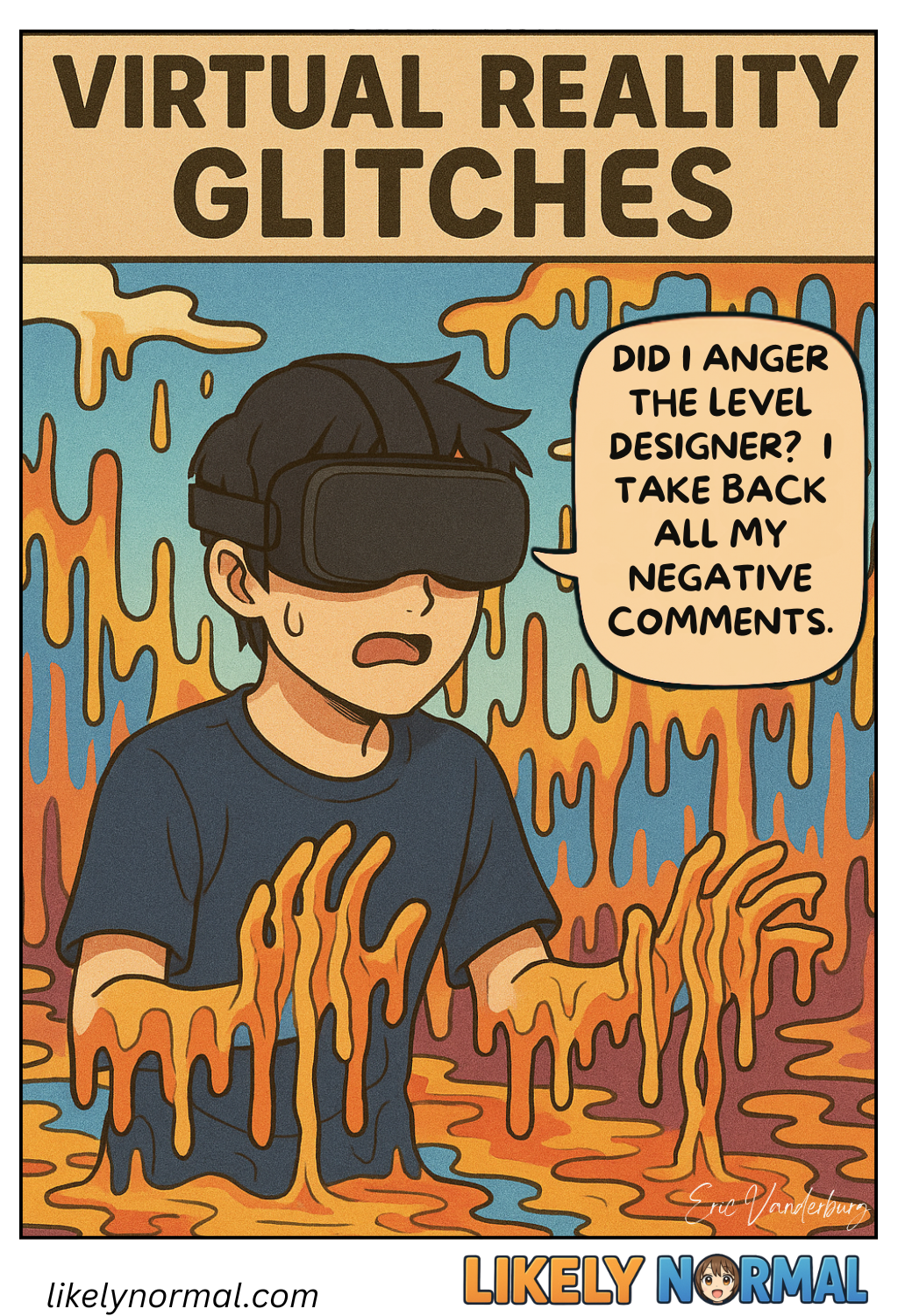
There’s nothing quite like the moment your high-tech virtual reality headset yanks you from total immersion into utter absurdity. One second you’re a fearless warrior battling dragons, the next you’re a floating pair of disembodied hands clipping through a castle wall like a digital ghost who forgot to fully materialize. VR promises otherworldly escapism—when it works. But when it glitches, it serves up existential horror comedy.
Take controller drift, where your in-game sword slowly levitates away from your grip like it’s being pulled by an invisible force, forcing you to awkwardly shuffle after it while your enemy stares in confusion. Or the classic floor calibration failure, which transforms your living room rug into a bottomless abyss, leaving your avatar’s legs knee-deep in the void while your upper body waves around like an inflatable tube man. Even better? When your VR voice chat cuts out mid-sentence, turning your strategic battle plans into frantic charades as your teammates watch you mime “Ambush from the left” with all the grace of a sleep-deprived octopus.
Then there’s physics engine betrayal—when you throw a virtual object only for it to ricochet off an invisible wall, fly back at Mach 5, and kill you. Or when your avatar’s hair gets stuck on a doorframe, stretching like taffy as you walk away until it finally snaps back, leaving you bald for the rest of the session. What could be work? How about eye contact glitches, where NPCs stare into your soul through the back of their own heads, or your friend’s avatar’s eyes rotate independently like a chameleon on espresso? Suddenly, your deep roleplaying session becomes a Cronenberg body horror film.
Discussion ¬